Why Ecological Engineering?
How Ecological Engineering provides sustainable outcomes that turn risk into value
What is Ecological Engineering
Ecological engineering is the design of sustainable systems that integrate human needs with natural processes.
Utimately it involves working out how people and nature can beneficially co-exist on planet earth - the grandest of all society’s challenges.
Ecological engineering combines the rigour of engineering, with basic and applied science from ecology, economics and natural sciences. The result is a healthy blend of ecology and technology that creates solutions to restore, protect, regenerate and better manage the environment alongside commercial interests.
We often refer to it as engineering the gap between the grey (what society needs) and the green (what nature needs) for the benefit of both.
We achieve this by designing nature-based solutions to environmental challenges that regenerate landscapes and transform risks into economic and social value.

Why is it relevant?
In the early 19th century, the Anglican clergyman and political economist, Thomas Malthus laid out the apocalyptic theory that geometric growth in the world’s population would exceed the planet’s ability to produce food and resources.
His views contrast directly with those of Nobel Prize winning economist Robert Solow, who in the mid-20th century expounded the theory that the world’s environmental and resource problems could be solved by technology and innovation.
Such advancements delivered the growth in agricultural production of the green revolution of the mid-20th century, and an array of processes that turn waste into valuable resources such as the Ostara process for recovering phosphorous and nitrogen from sewage effluent.
In today’s modern world we tend to rely on technology - traditionally engineered solutions that reduce problems to their component elements. As a result, environmental challenges are often approached as isolated problems - erosion is treated separately from vegetation, water quality is managed independently of soil health, and rehabilitation is measured by activity rather than outcome.
These approaches can deliver short-term progress, but they frequently fail to produce systems that function over the long term.
Ecological engineering takes a systems approach. It recognises that soils, water and vegetation are interconnected systems - and that durable outcomes depend on restoring how those systems function together - not just what they look like.
By blending the systems thinking approach of ecology, with the performance mindset of engineering, ecological engineers bring a balanced approach between Malthusian and Solovian principles to address how people and nature can beneficially co-exist on planet earth.
Why Conventional Approaches Fall Short
Many environmental and rehabilitation programs focus on visible activity:
How many trees have been planted?
How many areas have we stabilised?
Or they apply standard treatments across large sites without considering variations in the physical, chemical or biological condition of the landscape.
While these actions are important, they often fail to address the underlying drivers of system performance.
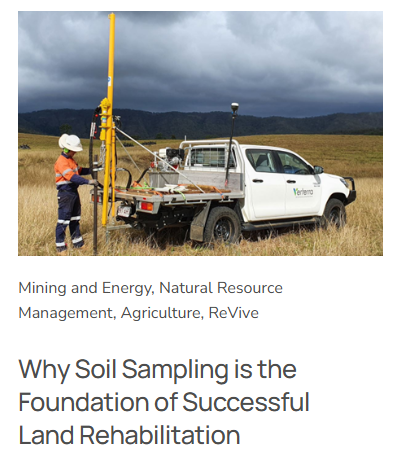
For more information read: Why Soil Sampling is the Foundation of Successful Land Rehabilitation
Common limitations usually include:
Treating symptoms rather than root causes
Ignoring soil constraints that limit vegetation success
Disrupting natural water movement and hydrological function
Measuring success through short-term indicators (e.g. % cover) rather than long-term stability
The result is often rework, declining performance over time, failure to meet closure and compliance expectations, or losing the opportunity to incorporate circularity into solution designs and generate long-term value.
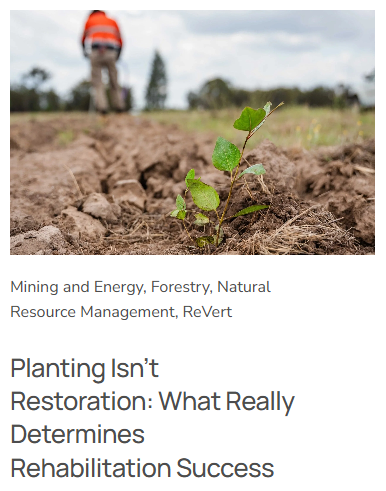
For more information read: Planting isn’t restoration: What really determines rehabilitation success
Insight
Insight
Why System Function Matters?
From an ecological engineering perspective, a landscape is not a collection of independent components. It is a dynamic system, driven by interactions between multiple factors and systems.
These include:
Soil structure and chemistry
Water movement and retention
Vegetation establishment and growth
Biological activity and nutrient cycling
If these interactions are not functioning correctly, desired outcomes will not be achieved - regardless of how much intervention is applied.
Ecological engineering focuses on restoring these interactions so that the system can retain and cycle water, support vegetation growth, resist erosion and degradation, and improve over time without ongoing intervention.
This is the real difference between activity and performance.
Integrating Soil, Water, Vegetation and Biodiversity
-
The foundation of system function. Soil structure, chemistry and biology determine water infiltration, root development and nutrient availability.
-
The primary driver of landscape processes. How water moves across and through a site determines erosion risk, vegetation success and long-term stability.
Effective environmental outcomes depend on how four core elements work together
-
Provides ground cover, stabilises soil and drives biological processes - but only succeeds when underlying soil and water conditions are suitable.
-
Supports resilience and system recovery, enabling landscapes to adapt to variability and disturbance over time.
When these elements are aligned, the landscape functions as a system.
When they are not, failure is inevitable.
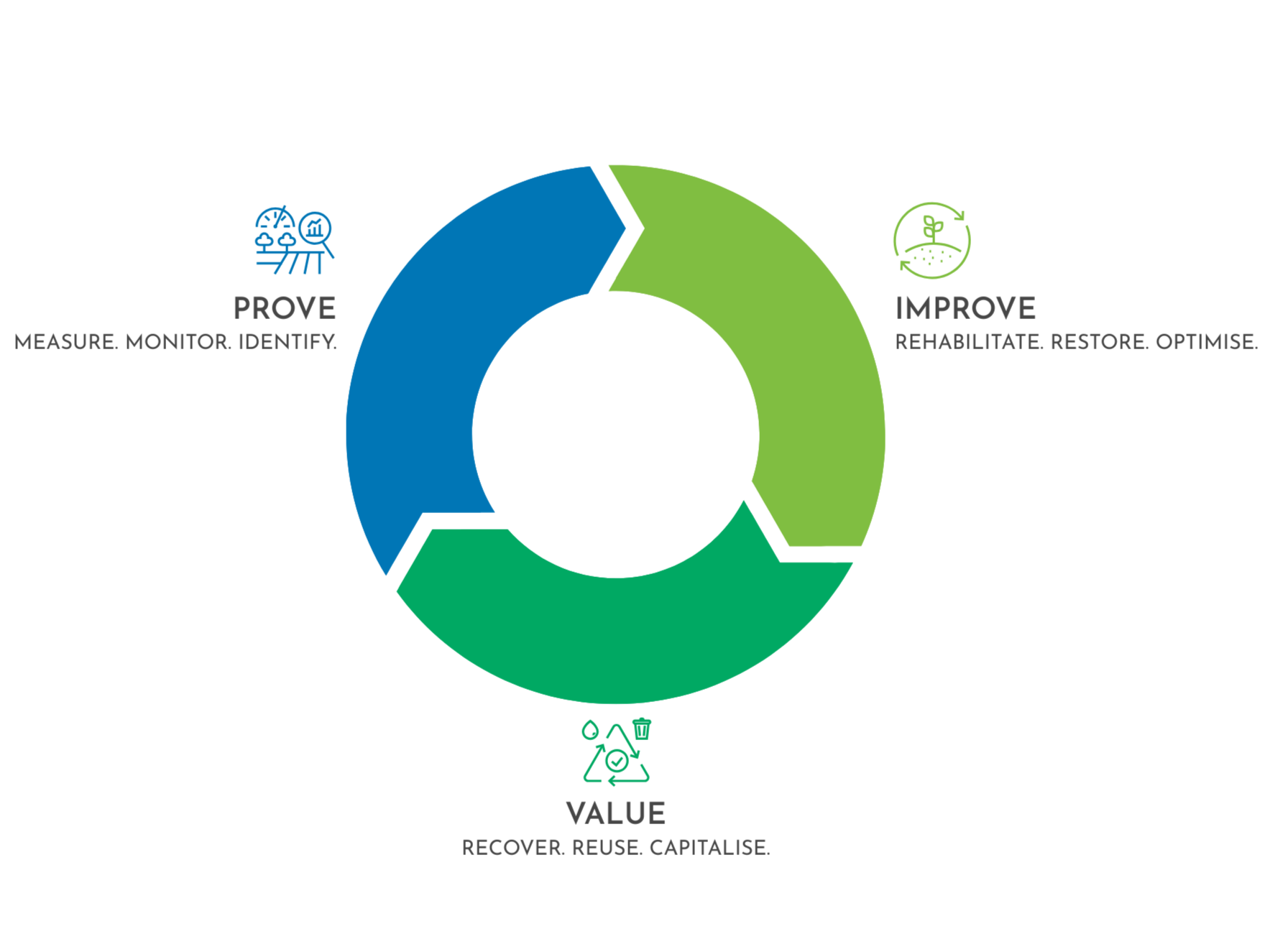
From Theory to Practice: The Performance Ecosystem
At Verterra, we apply ecological engineering approaches through our Performance Ecosystem:
PROVE: Measure and verify how the system is performing - not just what has been done.
IMPROVE: Design and implement interventions that address underlying constraints and restore system function.
VALUE: Generate long-term environmental and economic value from improved system performance.
This framework ensures that ecological engineering is not theoretical - it is applied - and its outcomes are measurable, defensible and aligned with real-world outcomes.
See Ecological Engineering in Practice
Dive Deeper into Our Thinking